
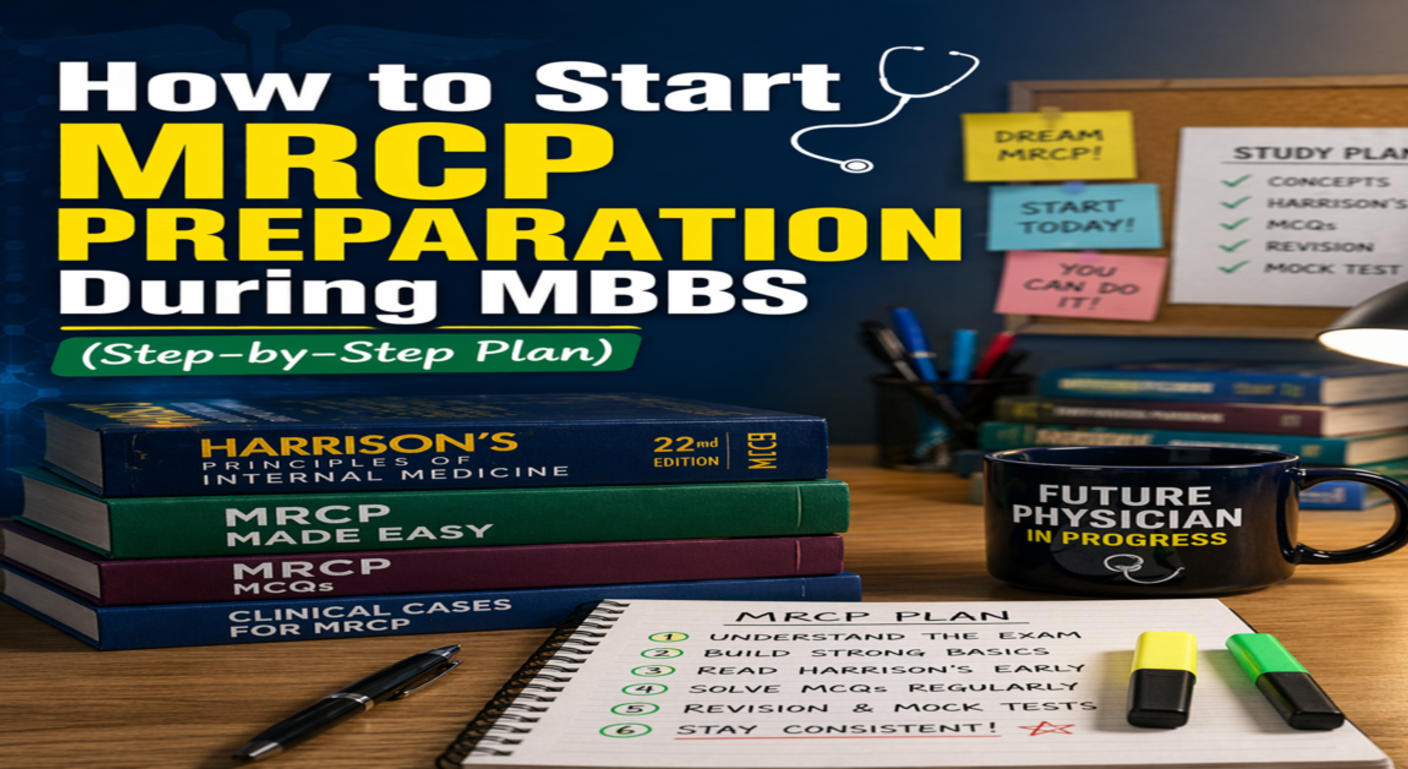
How to Start MRCP Preparation During MBBS (Step-by-Step Plan)
Rather than sitting back till degree completion, getting started now strengthens core knowledge. It sharpens how you approach patient cases. Confidence grows too, piece by piece. That kind of readiness matters – not just for passing exams but for handling real medicine well down the line.
Starting out on your MRCP path while still in MBBS? This guide walks through each move, one at a time. A clear route unfolds, built piece by piece. Instead of rushing ahead, you follow a steady sequence. Every stage connects naturally to the next. Think of it like building blocks – each part supports what comes after. The process fits around your medical studies. Nothing feels forced or out of place. Step follows step, smooth and straightforward.
Why Start MRCP Preparation During MBBS?
Starting MRCP prep only after finishing MBBS? That idea trips up plenty of learners. Truth is, understanding patients’ problems comes slower than you’d guess – practice shapes how minds link symptoms to causes.
Starting early helps you:
- Build a strong foundation in medicine
- Develop clinical thinking skills
- Reduce pressure after MBBS
- Improve performance in university exams + NEET PG simultaneously
Step-by-Step Plan to Start MRCP Preparation
Know How the MRCP Exam Is Set Up
Get clear on the goal before anything else kicks in.
- Stage one of MRCP procedure comes first. Following that is the second part. The process wraps up with the third section
- Science stuff meets real-life medicine
- Part 2: Advanced clinical knowledge
- PACES: Clinical examination skills
Start strong by mastering Part 1 ideas early. Clinical sense grows better when built alongside core topics. One feeds the other, slowly shaping real grasp. Learning sticks when theory links to practice. Early clarity helps later recall without extra effort. Concepts learned once, right, stay longer. Understanding patients comes easier with firm basics underfoot
Build Strong Basic Concepts
Thinking matters more than memorizing for MRCP exam. Aim your effort at understanding ideas, not just storing facts
- Understanding pathophysiology
- Linking theory with clinical scenarios
- Avoiding rote learning
Most learners hit a wall right here – this moment happens to be where DBA shifts things up entirely.
At Dr. Bhatia Academy (DBA), one of the best MRCP coaching in India where teaching follows a structured flow:
- Rapid recall through basic concepts using LMRP and MCQs.
- Free demo video lectures
- Test & discussion in video format
- High-yield Topic lectures
Because of this, grasping medical concepts feels more natural, almost how a doctor would see them.
Begin Early on Standard Medicine
Reading straight from books such as Harrison’s might just be the smartest routine to grow. A solid way to build knowledge? Open a real textbook instead of skimming online. Most overlook this – yet it works better than notes or summaries. Grabbing a classic medical text changes how your mind holds onto facts. Try starting there, not elsewhere, when learning deeply matters.
Begin by looking at key areas like the heart system first. The lungs come into play just after that. Hormone-related functions show up near the top too.
Don’t try to memorize everything.
- Focus on understanding mechanisms and clinical application.
- A little each day adds up – 30 to 45 minutes while studying medicine changes things slowly but surely.
Combine Multiple Choice Questions with Key Ideas
Wrong ideas pop up when learners tackle multiple choice questions before grasping the topic. Some jump straight into answers, skipping real learning first. A few think speed matters more than clarity. Others mix guesses with facts, blurring what they truly know. Without clear thinking, confusion grows quietly. Jumping ahead leads to shaky knowledge later on.
Correct approach:
- Study a topic → then solve MCQs
- Because it fits the pattern, that choice works. Where others fail shows what does not belong. One stands out since it matches the rule. The rest fall short when checked closely. This one holds up under closer look
- Focus on clinical reasoning
Picture this: tough multiple-choice talks that stick ideas to test moments. DBA builds those links fast. Need MRCP wins? This cuts through fog. Sharp focus comes alive where learning meets real questions. Yield rises when practice mirrors pressure. That connection matters most.
Create a Smart Study Plan While Doing MBBS
Most days, just showing up beats marathon sessions. Little by little adds up faster than you think.
A practical plan:
- 1–2 hours daily during MBBS
- Combine college subjects + MRCP concepts
- Saturday and Sunday: go over notes then try multiple choice questions.
- Integration matters more than piling things on.
Focus on Clinical Thinking Beyond Theory
Picture a real patient when facing MRCP questions. That thought keeps things grounded – case details matter most
“Why is this happening in the patient?”
Try to:
- Match how patients feel to what’s happening inside their bodies
- Think like a clinician, not a student
- Practice case-based discussions
Most of DBA’s instruction focuses on hands-on practice, so ideas from video lectures connect more easily to actual patient care.
Regular Revision and Mock Testing
Sticking things in memory often comes down to going over them again.
- Revise topics weekly
- Use short notes / rapid recall
- Attempt mock tests regularly
Every practice test at DBA comes with detailed feedback, so learners see how they’re growing while sharpening skills that need work. Results unfold over time, revealing patterns only clear through repeated effort. Growth shows up quietly, not in a single score but across attempts.
Common Mistakes to Avoid
- ❌ Starting preparation too late
- Wrong way: just remembering stuff without getting it
- ❌ Ignoring MCQs
- ❌ Lack of revision
- ❌ No structured guidance
Steer clear of these, yet your path through MRCP gets easier. Though small missteps add up, skipping them helps you move forward without slowing down.
How DBA Supports Early MRCP Prep?
What sets Dr. Bhatia Academy apart is its focus on deep understanding through real-world medical scenarios – this mirrors the core of MRCP preparation. Instead of memorizing facts, learners connect ideas using clinical context, making knowledge stick.
The structure follows how doctors actually think, not just what they recall. Because MRCP tests reasoning, the academy builds skills that go beyond textbooks. Learning happens by doing, guided by cases that challenge judgment. This method shapes confident decision-making over time.
DBA gives you
- 350+ hours of structured medicine lectures
- 400+ high-yield discussions
- Personalized Mentorship by Dr. Mukesh Bhatia
- 20+ full syllabus mock tests
- Teaching integrated with Harrison’s 22nd Edition
Multiple choice questions come with practice exams. A guide walks you through each step. Support sticks around when things get tough
A Clear Roadmap Using the DBA Way
Starting sooner helps MBBS students keep going without slowing down, which leads to better results over time.
Final Takeaway
What if beginning MRCP prep in MBBS isn’t loading extra work, yet refining how you learn? Instead of piling on hours, it shifts your rhythm – focusing effort where it counts.
If you focus on:
- Strong concepts
- Clinical thinking
- Regular practice