
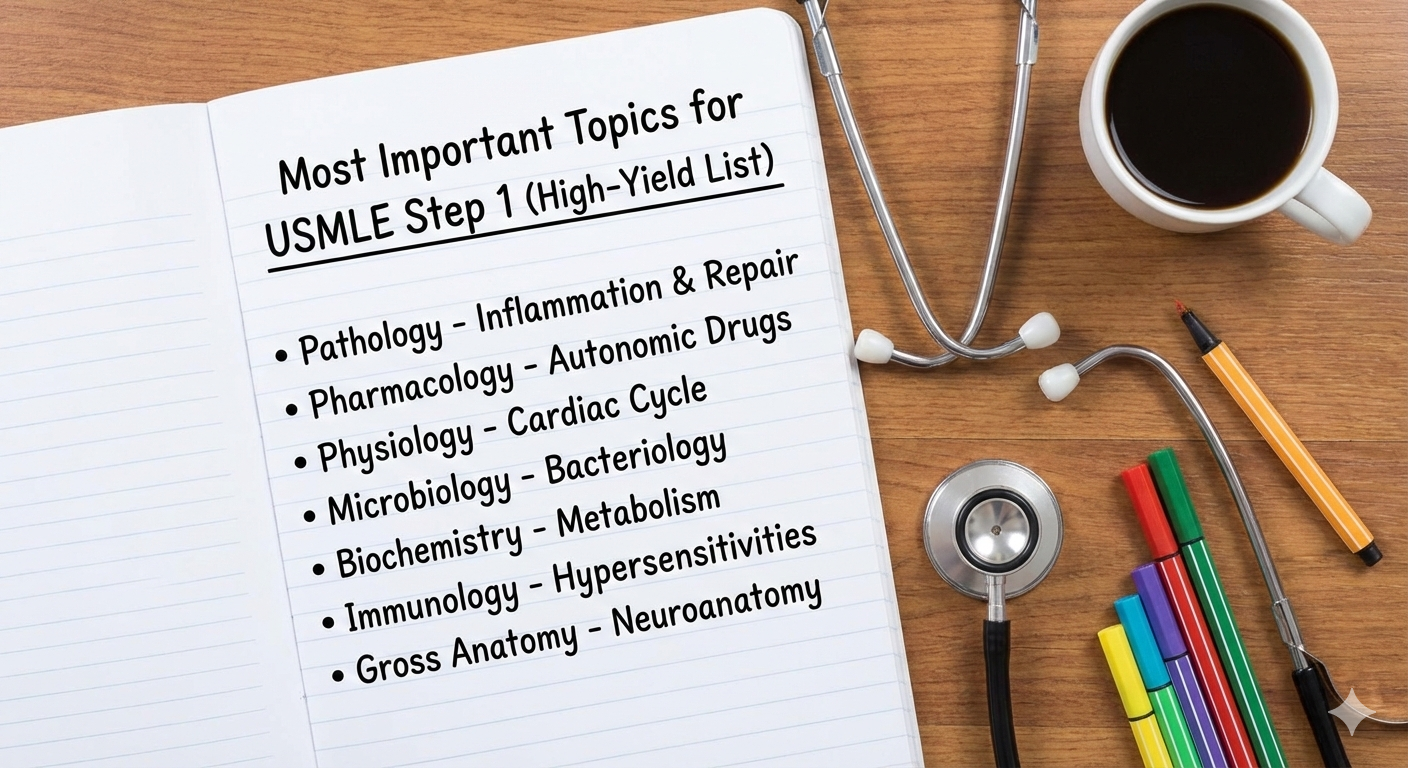
USMLE Step 1 challenges you with a tough, concept-driven test that checks your grasp of basic sciences while pushing you to connect that knowledge to clinical cases. Earning a top score takes more than just memorizing facts. It needs solid understanding clear reasoning, and combining ideas from different subjects.
Below, you’ll find a key list of crucial topics that show up in USMLE Step 1 syllabus alongside tips on how to get ready for the exam.
-
Biochemistry (Super Important)
Biochemistry is a core part of Step 1 and often shows up tied with topics like genetics, pathology, and pharmacology.
Key things to study:
- Metabolic routes: Glycolysis, Krebs cycle, electron transport chain, beta-oxidation
- Enzyme behavior and control
- Genetic metabolic disorders
- Vitamins and helper molecules
- Molecular biology basics: DNA copying, RNA creation, protein synthesis
- Communication pathways in cells
Tip: Focus on why certain pathways are controlled, not just memorizing the sequence of steps.
-
Physiology (Core Knowledge)
Physiology plays a big role in tests and is very important in clinical settings.
Key systems to know:
- Cardiovascular physiology, including the cardiac cycle and pressure-volume loops
- Respiratory physiology covering topics like V/Q mismatch and the oxygen dissociation curve
- Renal physiology, focusing on acid-base balance, clearance, and the RAAS system
- Endocrine feedback systems and how they are regulated
- The basics of neurophysiology
A lot of pharmacology and pathology questions hinge on understanding physiology concepts.
-
Pathology (The Core of Step 1)
Pathology ties together the foundational sciences and takes center stage in Step 1.
Key topics to focus on:
- General pathology like inflammation, necrosis, and apoptosis
- Neoplasia, including tumor suppressor genes and oncogenes
- Systemic pathology involving the cardiac, renal, respiratory, and GI systems
- Understanding disease mechanisms rather than just memorizing descriptions
Always think: How does this work?
-
Pharmacology (Important and Scoring)
Pharmacology questions show up often and are easy to score on if you know the concepts well.
Main areas:
- Drugs affecting the autonomic system
- Heart-related drugs like those for hypertension or arrhythmias
- Antibiotics and how resistance develops
- Drugs for the nervous system
- Side effects and when drugs shouldn’t be used
Connect drugs with how the body works and disease processes to remember them better.
-
Microbiology (Memorize + Think)
Microbiology needs good memorization combined with logical clinical thinking.
Focus on key areas:
- Types of bacteria (gram-positive and gram-negative)
- Viruses and their features (DNA or RNA presence of an envelope site of replication)
- Fungi and parasitic organisms
- How the immune system responds to infections
- Basics and importance of vaccines
Look for patterns and connections rather than focusing on standalone details.
-
Immunology (Popular Exam Topic)
Immunology questions often combine ideas in tricky and connected ways.
Key topics to study:
- The four types of hypersensitivity reactions
- Disorders related to immunodeficiencies
- Conditions caused by autoimmune responses
- Roles of cytokines and immune cells
- The process behind transplant rejection
A solid grasp of immunology helps in USMLE Step 1 and Step 2 exams.
-
Neuroanatomy and Neuroscience
A section many find intimidating but can fetch good marks with a clear conceptual grasp.
Key subjects to focus on:
- Brainstem problems and cranial nerves
- Spinal cord disorders
- Chemicals in the nervous system
- Diseases causing brain degeneration
Use visuals and study pathways to excel.
-
Behavioral Science & Biostatistics
Many ignore this part, yet it’s a chance to secure easy points.
Must-study areas:
- Types of study methods
- Common errors like bias and confounding
- Measures like sensitivity, specificity, PPV, NPV
- Ethical guidelines and patient protection
solve calculation questions.
-
Genetics (Found Everywhere)
Genetics pops up across various chapters.
Critical areas to review:
- Ways traits are inherited
- Chromosome-related conditions
- DNA changes and repair methods
- Basics of genetic counseling
How Dr. Bhatia Academy (DBA) Supports USMLE Step 1 Study?
Understanding these topics and in an organized way can be tough without expert guidance. Dr. Bhatia Academy (DBA) provides that essential support through its well-organized learning application which pre-recorded video lectures, test & discussion, mock tests and much more.
DBA’s strategy for USMLE prep includes:
- Building a strong understanding of basics
- Focusing on ideas instead of memorizing facts
- Connecting clinical concepts across all subjects
- Combining preparation, benefits for USMLE, MRCP, NEET PG, and INICET
- Offering well-planned schedules and exam-focused methods through its application
DBA guides students to approach learning the way USMLE wants them to—by connecting physiology, pathology, pharmacology, and biochemistry into a single clinical understanding instead of isolating each subject. You need to subscribe to one of our USMLE Plans to access full syllabus of USMLE.
Final Words
USMLE Step 1 values clear understanding logical reasoning, and the ability to integrate concepts. Focusing on key high-yield topics with a solid plan can greatly boost your performance and USMLE Step 1 passing score. By putting in regular effort, revising smartly, and using concept-driven support—like what Dr. Bhatia Academy (DBA) provides—you can turn Step 1&2 into an attainable goal.
“Building strong basics today creates confident doctors for tomorrow”
For more information:
📞 +91 9315128989 | +91 8383088439
🌐 drbhatiaacademy.com